When Patients See What You See
135 million patients’ claims already run through AI. Yours could too.
A look at the FDA-cleared diagnostic AI now built into Sensei imaging — what it flags, why it catches what a rushed exam misses, and what it means for the claims already crossing your front desk.
run through Overjet — the world leader in dental AI.
periodontal disease is diagnosed. Fatigue and time pressure cost findings.
increase in case acceptance reported by providers using Overjet for patient education.
Why AI, and why now?
Patients today don’t take a diagnosis at face value the way older generations often did. They research, they compare, they want to see evidence before they commit to treatment — the same instinct that drives them to check reviews before booking a hotel room. When a dentist says “you need four fillings” and a longtime family dentist elsewhere says “everything looks fine,” patients are left caught between two opinions with no way to referee the disagreement.
AI doesn’t replace clinical judgment, but it gives both sides something objective to look at: the same enhanced image, the same measurements, the same flagged areas — visible to the dentist and, increasingly, to the payer adjudicating the claim. As the film above puts it: 135 million patients in the U.S. already have their dental claims reviewed by artificial intelligence, and 95% of those claims run through Overjet specifically. Whether or not a practice has adopted the tool yet, the review standard on the other end of the claim already has.
How the AI actually works
A common misconception is that this is just a chatbot-style AI making a guess. It isn’t. The models are trained on millions of radiographs that were first reviewed by large panels of licensed dentists. Rather than training on every area where even a single reviewer thought they saw something — which would flag decay everywhere — the system trains only on the areas where a strong majority of clinicians agreed, filtering out noise in favor of genuine consensus.
From there, specialized models are layered together: one focused on the cementoenamel junction, another on enamel, others on bone level, restorations, and caries. Each contributes its “opinion,” and all of them are stacked and presented to the dentist — who remains the final decision-maker. Nothing the AI flags is automatically accepted; it directs attention, it doesn’t dictate a diagnosis.
What shows up on the radiograph
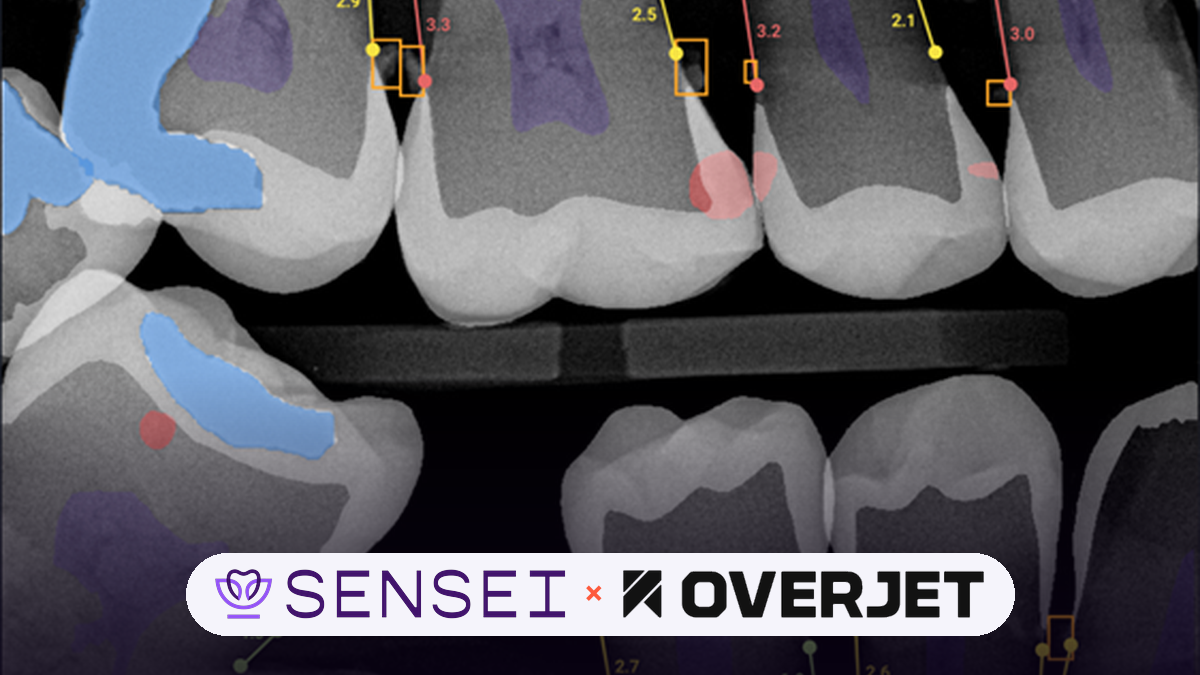
Once integrated with imaging software, every new radiograph gets a run-through, and findings appear directly on the image:
- Color-coded severity. Incipient caries are marked yellow; caries that have progressed past the DEJ turn red — an intuitive cue dentists can use directly with patients (“we don’t want the red to reach the purple”).
- Bone-level measurement without a reference object. Rather than needing a known constant like a file of a set size, the system measures bone loss directly from the sensor’s own properties — green for healthy (0–2mm), yellow for moderate loss (2–3mm), red for advanced loss (3mm+).
- Full clinician control. Every finding can be hidden or dismissed outright if the dentist disagrees. The AI suggests; the dentist decides what the patient ultimately sees.
- Longitudinal comparison. Radiographs from past visits can be pulled up side by side, turning “here’s what changed” into a picture instead of a conversation.
Still being written — but some things are certain
How artificial intelligence fits into patient care is still an open question across medicine, not just dentistry — the field is working that out in real time. A few things aren’t up for debate, though. FDA clearance is one of them. Overjet’s caries detection and bone-level measurement are FDA-cleared, not simply “AI-powered” — a distinction that matters the moment a tool is informing a diagnosis or a claim.
The other certainty is a harder conversation, and it comes up in every field applying AI, from writing tools to self-driving cars: what happens to a person’s own skill when a machine starts doing part of the work? Left unchecked, the risk is real — hand enough of a task to a model and the human’s own ability to perform it can quietly erode.
Overjet is built against that outcome, not toward it. Every finding is a suggestion a dentist reviews, confirms, or dismisses — never an answer delivered in place of one. Used this way, clinicians aren’t stepping back from reading radiographs; they’re getting a second opinion on every image, which sharpens the read rather than replacing it.
More situational awareness, not less
The pattern that shows up across every well-designed AI tool, whatever the task, is that it keeps the person engaged rather than checked out. Adaptive cruise control is a familiar version of this: it doesn’t take the driver out of the loop, it takes over the repetitive, autonomic-level work of holding a following distance — freeing up attention for what actually matters, like a merging lane or a light about to change.
Overjet works the same way in the operatory. Scanning a full series for anything a tight schedule might cause a clinician to overlook is exactly the kind of repetitive pattern-matching a model can sit underneath a dentist’s judgment. That doesn’t mean less attention from the provider — it means the provider’s attention goes where it’s actually needed: the patient in the chair, not a fifth pass over the same film. Even when the schedule runs long, the findings still surface, and nothing important gets missed for lack of time.
less periodontal disease gets diagnosed in a rushed exam. Not because clinicians aren’t skilled — because a three-to-seven-minute hygiene check leaves little room for a second look. That’s the gap this kind of AI is built to close, not a clinician it’s built to replace.
The insurance side of the equation
The platform calculates a decayed-missing-filled (DMF) score for each affected tooth. Teeth scoring above roughly 50% tend to get approved with little friction; those below that threshold are often denied unless supported by additional documentation — an intraoral photo, a narrative, a pulp vitality test. Knowing that score before submitting a claim means assembling the right evidence up front instead of resubmitting after a denial. The same logic applies to periodontal claims: scaling and root planing can be denied as routine cleaning if bone-level measurements don’t support significant loss, regardless of pocket depth alone — and bone level is exactly what the AI is already measuring.
What it means for the patient conversation
The clearest payoff might be the simplest one. Providers using Overjet for patient education report a 25% increase in case acceptance. Showing a patient the same enhanced image and the same color-coded findings a clinician is reading — rather than describing shades of gray — turns “trust me” into “look at this.”
FDA-cleared diagnostic AI, trained on millions of radiographs.
Caries, calculus, and bone-level measurement — flagged on the radiograph, reviewed by you.